
I just love this, it is a motto for myself and my kids. Chris Sacca is a successful start-up investor in San Fransisco. You can watch his commencement speech here.

I just love this, it is a motto for myself and my kids. Chris Sacca is a successful start-up investor in San Fransisco. You can watch his commencement speech here.
This quote is similar to yesterday’s. Mostly, I believe, we should be conduits for the opportunities that come into our lives. We are meant to cultivate our gifts and then share them with the world, like those who have come before and are among us who are sharing their amazing gifts with us. Think of how different our lives would be without Henry Ford, or the Wright Brothers, or Bill Gates, or Steve Jobs, or Google, or a thousand other people who have contributed to the betterment of the rest of us.
Amanda Palmer is a singer/songwriter who started her career as a busker, or street performer in Boston, and travelled around the world busking. While busking, she developed her musical career as a partner in the band The Dresden Dolls. She was signed by a label, fought to get out from under their grasp before her second album release, and raised over $1 million dollars on kickstarter for an independent album. She faced a ton of critisism for raising that kind of money. I don’t follow her career, and don’t listen to most of her music, but I’ve always loved “Coin Operated Boy.” I came across her Ted Talk by chance and recognized her enough to dig a little deeper. Her book, The Art of Asking is a story of bravery.
This is a mormon scripture that really struck me when I heard it. For me, this quote explains why we have strengths and weaknesses, and the purpose for culitvating our strengths and developing our talents to share with the world. Great cities are not built by a single person. Any great task usually takes a comittee. We are here to care for each other, and we all have something to contribute. The gifts and talents that we develop are best when shared.
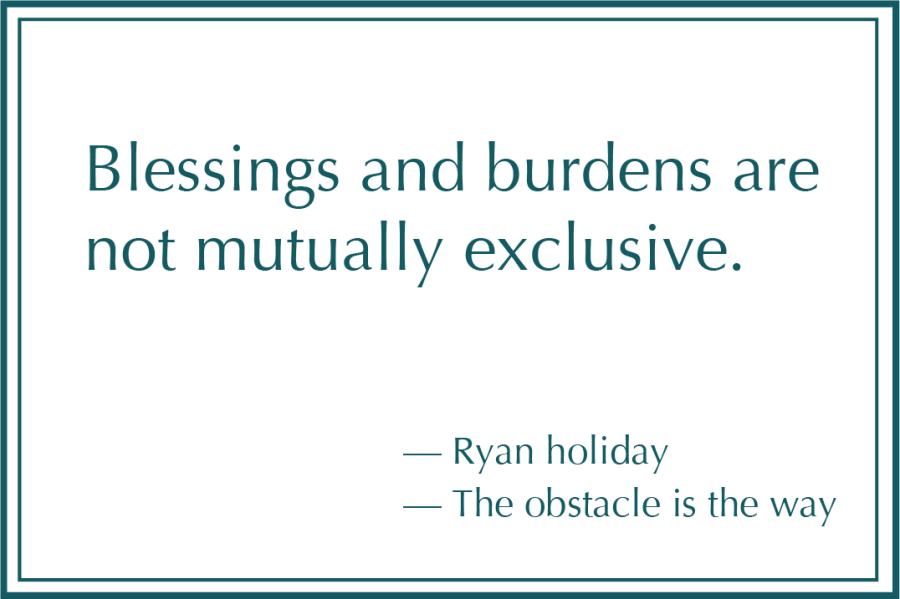
This quote by Ryan Holiday has been going through my mind a lot lately.
We recently lost a $100,000 customer, which is a tenth of our business. This is oh, so painful. But I sat down and wrote a list of the hard things I’ve been through. They include:
Moving high schools my sophomore year. From here, that doesn’t look like something “hard,” but at the time, I was self-conscious and felt conspicuous, eating lunch alone, and really didn’t make any friends until the end of that year.
Multiple miscarriages.
My husband lost his job when I was a stay at home mom of 10 years.
Our production manager who had worked at the shop for 25 years gave his notice.
Of course there are other hard things, broken bones, broken hearts, temporary health and financial setbacks, but these are some of the bigger ones I can think of.
I wrote this list to remind me that hard times don’t last forever, and that we get through them, and usually come out the other side stronger, and having learned invaluable lessons. Hard hurts so good.
I can look back and follow this “hard things” list up with the blessings that followed.
Moved high schools sophomore year – Made the best friends I ever could have dreamed of.
Frequent miscarriages – We got to adopt our amazing girl.
Husband loses his job – We become business owners, and I learn so much and get to work with really great people.
We lose our shop manager – We step up and run the shop our way and learn how to delegate and put systems in place, and build a great business.
We lose one of our largest customers – I don’t know, but I trust that something good is coming.
Josh Waitzkin is a child chess champion and martial arts world champion. I’ve animated one of my favorite excerpts from his book, The Art of Learning. In the book, he talks about his experiences and training tactics for chess and push hands. He shares some of the performance training tactics that he has mastered.
Waitzkin’s book was my first introduction to Growth vs. fixed mindset.
Other sources you might like:
Carol Dweck’s Ted Talk: The Power of Believing that you can Improve
Josh Waitzkin’s interview with Tim Ferriss
 ideastudios.blog